The most common point of failure in modern pool construction is not plumbing or structural engineering—it is inadequate electrical infrastructure that fails to support the combined load of modern pool technology. Homeowners and contractors frequently underestimate the total amperage required for a modern pool, leading to overloaded subpanels, tripped breakers, NEC (National Electrical Code) compliance failures, and expensive post-installation trenching or rewiring. Properly sizing the electrical load requires evaluating the specific power draw of every component on the pad. You cannot simply run a standard 50-amp line and expect it to handle variable-speed pumps, heat pumps, and automation systems simultaneously. This guide breaks down how to calculate requirements, adhere to strict safety codes, and future-proof the electrical subpanel for a full set swimming pool equipment installation.
Subpanel Sizing is Critical: A standard 50-amp subpanel is rarely sufficient for modern setups; a 100-amp dedicated subpanel is the baseline for systems utilizing heat pumps, automation, and variable-speed pumps.
Strict NEC Compliance: All pool-related electrical circuits require GFCI protection, strict adherence to clearance distances (e.g., receptacles placed 6 to 10 feet from the water's edge), and proper equipotential bonding.
Component-Specific Loads: Filtration, heating, and sanitation components operate on different voltages (120V vs. 240V) and require dedicated circuits to prevent system-wide shutdowns during a single-component fault.
Future-Proofing Saves Capital: Installing oversized conduit and higher-gauge wire during initial trenching costs marginally more upfront but prevents thousands of dollars in rework when adding UV/Ozone systems or robotic cleaners later.
Understanding the Power Demands of a Complete Pool Equipment System
A successful electrical plan must support the continuous running load of primary equipment while accommodating the peak startup surge of heavy motors without voltage drop. When you design the electrical layout for a complete pool equipment system, you are dealing with a mix of high-draw continuous loads and intermittent ancillary loads. Failing to account for the inrush current of a 3HP pump or the massive draw of an electric heat pump will result in nuisance tripping and premature equipment failure.
Primary vs. Ancillary Electrical Loads
We divide pool pad electrical loads into two distinct categories: primary and ancillary. Primary loads are the heavy hitters that dictate the size of your subpanel and the gauge of your feeder wire. These include variable speed pumps (VSPs), heat pumps, gas heater electronic ignitions, and salt water chlorine generators (SWCG). Heat pumps alone can pull 40 to 50 amps on a 240V circuit, instantly maxing out older 50-amp subpanels.
Ancillary loads draw significantly less power but add up quickly when combined. These include LED lighting for the pool and spa, UV/Ozone sanitation systems, automation panels, and convenience receptacles. While a single LED pool light might only draw 1 amp via a 12V transformer, running multiple lights, a landscape lighting transformer, and a robotic cleaner receptacle requires careful circuit mapping.
| Load Type | Component | Typical Voltage | Estimated Amperage Draw |
| Primary | Variable Speed Pump (3HP) | 240V | 10 - 16 Amps |
| Primary | Electric Heat Pump | 240V | 40 - 50 Amps |
| Primary | Salt Water Chlorine Generator | 120V / 240V | 5 - 8 Amps |
| Ancillary | LED Pool Lighting (via Transformer) | 120V | 1 - 3 Amps |
| Ancillary | UV / Ozone Sanitation System | 120V / 240V | 2 - 6 Amps |
| Ancillary | Automation Control Panel | 120V | 3 - 5 Amps |
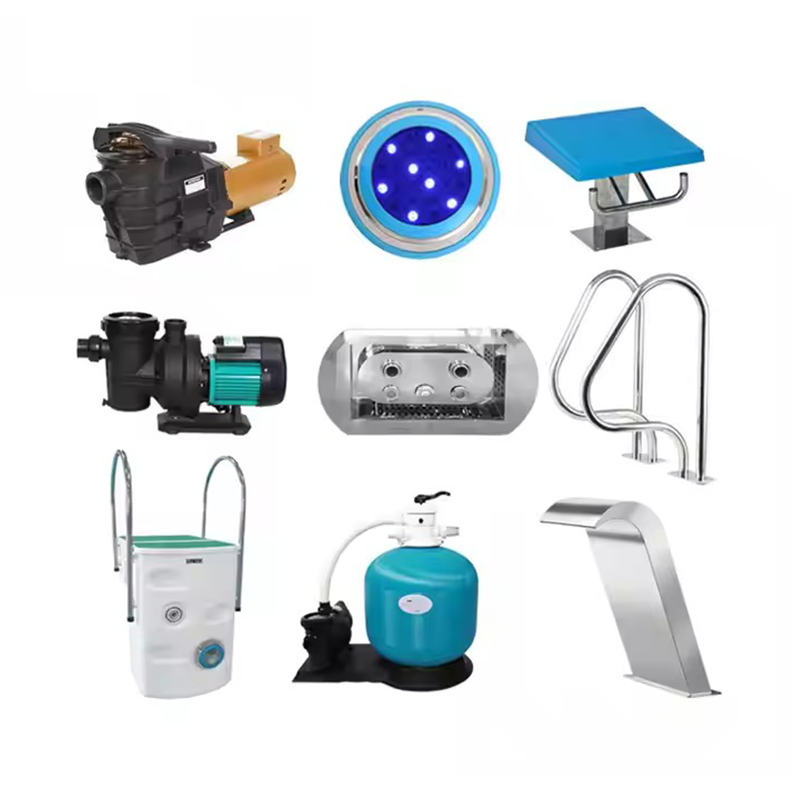
Evaluating the Pool Filtration Equipment Set
The industry shift from single-speed to variable-speed pumps has fundamentally changed how we approach electrical planning. Older single-speed pumps ran for 8 hours a day at maximum draw. Modern VSPs run for up to 24 hours a day at much lower speeds. While VSPs are highly efficient, they almost exclusively require dedicated 240V circuits. Their continuous low-speed operation impacts overall daily load calculations, meaning your subpanel must provide a stable, uninterrupted power supply. When sizing a pool filtration equipment set, you must look at the maximum amp draw listed on the pump motor's data plate, not just the running amps.
Secondary filtration components also demand attention. Booster pumps for pressure-side cleaners require their own dedicated 240V or 120V circuit, often tied to a relay in the automation panel to ensure they only run when the primary filtration pump is active. In-ground systems utilize hardwired 240V commercial-grade setups housed in weatherproof conduit. Conversely, above-ground packages often rely on twist-lock L5-20R or standard 120V GFCI outlets. These cord-and-plug setups have strict NEC restrictions regarding cord length and receptacle placement to prevent extension cord usage.
NEC Standards and Safety Requirements for Pool Electrical Systems
Navigating the 2023 NEC (Article 680) requirements ensures the installation passes municipal inspection and protects users from electrocution. Water and electricity are a lethal combination. The code is highly specific about how power is delivered, protected, and grounded around a body of water.
GFCI Protection and Dedicated Circuits
All pool-related electrical circuits must be GFCI (Ground Fault Circuit Interrupter) protected. This includes pumps, lights, heaters, and convenience receptacles. The NEC mandates Class A GFCI protection, which trips when the current imbalance reaches 4 to 6 milliamps. You must install dedicated breakers for each major component. Putting the pool pump and the salt cell on the same breaker is a recipe for nuisance tripping. Isolating faults ensures that a failed salt cell transformer does not shut down your primary filtration pump, turning the pool into a stagnant swamp while you wait for repairs.
The Critical Distinction Between Grounding and Bonding
Many contractors confuse grounding and bonding, but they serve entirely different safety functions. Grounding directs errant electrical current back to the panel and into the earth to trip a breaker during a short circuit. It protects the equipment. Equipotential bonding protects the swimmers. Bonding connects all metal components—pump motors, heater housings, pool structure rebar, handrails, and underwater light niches—with an 8 AWG solid bare copper wire.
This continuous copper loop connects to a bonding lug on the equipment pad. It creates an equipotential grid, ensuring that all metal parts and the water itself are at the exact same electrical potential. If a stray voltage enters the water, the bonding grid prevents a voltage gradient, meaning the electricity will not use a swimmer's body as a path to ground. All modern pool pumps include a specific bonding lug on the motor housing for this final connection point.
Distance and Placement Regulations
The NEC enforces strict distance requirements to keep electrical hazards away from wet zones. Electrical equipment, including the subpanel and automation board, must be installed at least 5 feet horizontally from the inside wall of the pool. Pool pump power outlets and convenience receptacles must be a minimum of 6 feet, but not greater than 10 feet, from the inside edge of the pool. This specific window ensures the receptacle is close enough to plug in a robotic cleaner without an extension cord, but far enough away to prevent splashing.
Overhead clearance rules are equally strict. You must maintain a minimum of 12 feet of clearance above the pool for specific installations, including overhead utility lines and lighting fixtures. Underground wiring must be buried at specific depths depending on the conduit type—typically 18 inches for PVC conduit and 6 inches for rigid metal conduit.
Step-by-Step Electrical Load Calculation for a Full Set Swimming Pool Equipment
Sizing the subpanel correctly involves mathematically calculating the aggregate amperage of the selected equipment. You cannot guess this number. You must pull the spec sheets for every piece of equipment and calculate the total continuous and non-continuous loads.
Amperage and Voltage Requirements by Component
Every component on the pad has specific voltage and amperage requirements. Here is a breakdown of standard draws:
Pumps: 240V / 10-15 Amps. Variable speed pumps require 240V for optimal efficiency.
Heat Pumps: 240V / 40-50 Amps. This is always the largest draw in the system and requires heavy-gauge wire (usually 6 AWG or 4 AWG).
Gas Heaters: 120V or 240V / <5 Amps. Gas heaters only use electricity for the digital display, sensors, and electronic ignition.
Salt Cells / UV / Ozone: 120V or 240V / 5-10 Amps. These sanitation devices run concurrently with the pump.
LED Lighting: 12V (via transformer on a 120V circuit) / <5 Amps. Modern LEDs are highly efficient but require a step-down transformer.
Sizing the Pool Subpanel (60-Amp vs. 100-Amp)
To size the panel, use this calculation framework: (Total Continuous Load x 125%) + Non-Continuous Load. A continuous load is anything that runs for 3 hours or more, which includes your VSP and heat pump. A 60-amp panel is generally sufficient for a basic setup featuring a gas heater, a single VSP, a salt cell, and LED lights.
However, a 100-amp panel is mandatory for systems utilizing electric heat pumps, multiple booster pumps, and full automation. If you install a 60-amp panel and later decide to switch from gas heating to an electric heat pump, you will have to rip out the entire electrical feed and start over. Upgrading to a 100-amp panel during initial construction provides the necessary headroom for future additions.
Main Service Panel Capacity: Upgrading to 200A or 400A Service
Before trenching a single foot of conduit, you must evaluate whether the home's existing main service panel has the remaining capacity to feed a 60A to 100A pool subpanel. Overloading a standard 100A or 150A home service when adding a pool is a massive risk. If the home has electric ranges, electric dryers, and multiple HVAC units, adding a 100A pool panel will likely exceed the main breaker's capacity.
Coordinating a main panel upgrade to 200A or 400A early in a custom home build or renovation avoids massive project delays. You must perform a residential load calculation (NEC Article 220) on the main house panel to prove to the municipal inspector that the existing service can handle the new pool subpanel.
Integrating a Pool Cleaning Equipment Set and Automation
Modern smart controllers and automated cleaning systems impact electrical planning significantly. The days of simple mechanical timers are over. Today's pool pads are networked hubs that require low-voltage communication wiring alongside high-voltage power feeds.
Powering the Pool Cleaning Equipment Set
The type of cleaner you select dictates the electrical rough-in. Traditional pressure-side booster pumps require a dedicated 240V or 120V circuit wired into a high-voltage relay inside the automation panel. Modern electric robotic cleaners operate differently. They require a standard 120V GFCI convenience receptacle located near the pool pad or patio. When planning a pool cleaning equipment set, verify the cord length of the robotic cleaner to ensure the GFCI receptacle is placed within reach, adhering to the 6-to-10-foot NEC distance rule.
Smart Controllers and Low-Voltage Relays
Automation panels act as the central electrical hub for the entire backyard. They utilize low-voltage relays to control high-voltage equipment. The main power feeds into the automation board's breaker base, and individual circuits are routed through the relays to the equipment.
You must also plan for low-voltage wiring. Actuators (automated valves that switch water flow between the pool and spa) require 24VAC power routed back to the automation board. Furthermore, communication cables (RS-485) must be run between the VSP, the salt cell, the heat pump, and the automation board. These low-voltage communication wires must be run in separate conduits from the high-voltage power lines to prevent electromagnetic interference (EMI) from disrupting the digital signals.
Mechanical Timers vs. Advanced Automation Control
Older mechanical timer setups, like the classic Intermatic T104 dual-voltage timers, are obsolete for modern variable-speed setups. Mechanical timers physically cut power to the equipment. If you cut power to a VSP, it loses its internal programming and communication with the automation system.
Modern digital control panels supply constant power to the VSP and control its speed and schedule via the RS-485 communication wire. Advanced automation also alters load sequencing. For example, the system will schedule the gas heater to fire only when the primary filtration pump is running at a sufficient RPM to close the heater's pressure switch. This prevents dry-firing and catastrophic equipment damage.
Implementation Risks and Cost-Influencing Factors
Balancing upfront installation costs with long-term scalability and safety requires strategic planning. Cutting corners on conduit sizing or wire gauge will cost you exponentially more in the future.
Trenching, Conduit Sizing, and Wire Gauge Realities
Trenching from the main house panel to the pool pad involves significant labor, especially if you have to cut through existing concrete or navigate mature landscaping. Because trenching is expensive, undersizing the conduit is a terrible mistake. Specifying 1.5-inch or 2-inch Schedule 40 PVC conduit is a low-cost insurance policy against future wire pulls. It gives you plenty of room to pull thicker wire or add additional circuits later without exceeding conduit fill limits.
Voltage drop is a critical factor over long distances. If the pool pad is located 150 feet away from the main house panel, standard wire sizing charts no longer apply. You will experience a voltage drop that can cause motors to run hot and burn out prematurely. For long runs, you must up-size the wire gauge—for example, moving from 6 AWG to 4 AWG or even 2 AWG THHN copper wire—to maintain a stable 240V at the equipment pad.
| Subpanel Amperage | Distance from Main Panel | Recommended Copper Wire Gauge (THHN) |
| 60 Amps | Up to 50 feet | 6 AWG |
| 60 Amps | 100 to 150 feet | 4 AWG |
| 100 Amps | Up to 50 feet | 3 AWG |
| 100 Amps | 100 to 150 feet | 1 AWG or 1/0 AWG |
Future-Proofing the Pad
Always leave 2 to 4 open breaker slots in the pool subpanel. This mitigation strategy allows for future upgrades, such as adding a dedicated circuit for a backyard kitchen, landscape lighting transformers, or an upgraded UV/Ozone sanitation system. Upgrading a maxed-out subpanel requires replacing the entire enclosure and potentially pulling new feeder wires. Leaving open slots costs nothing during the initial build and provides total flexibility for backyard expansions.
Conclusion
Calculate the total continuous and non-continuous loads accurately based on equipment data plates before selecting a subpanel size.
Verify that the home's main service panel has the capacity to support a new 100-amp pool subpanel, and schedule a heavy-up upgrade if necessary.
Install oversized 1.5-inch or 2-inch PVC conduit during the initial trenching phase to easily accommodate future wire pulls.
Ensure all metal components, water, and the pool shell are properly tied into the equipotential bonding grid using 8 AWG solid copper wire.
Leave at least two open breaker slots in the new subpanel to support future backyard additions like robotic cleaners or landscape lighting.
FAQ
Q: What size subpanel do I need for a pool?
A: A 100-amp dedicated subpanel is the baseline for modern pools utilizing electric heat pumps, variable-speed pumps, and automation systems. A 60-amp panel is only sufficient for basic setups relying on gas heaters and minimal ancillary equipment.
Q: Does pool equipment need GFCI protection?
A: Yes. The NEC mandates Class A GFCI protection for all pool-related electrical circuits, including pumps, heaters, underwater lights, and convenience receptacles, to prevent electrocution in wet environments.
Q: What is the difference between grounding and bonding in a pool?
A: Grounding directs errant electrical current to the earth to trip a breaker and protect equipment. Equipotential bonding connects all metal parts with a copper wire to create a uniform voltage grid, protecting swimmers from shock.
Q: How far must electrical outlets be from the pool?
A: Convenience receptacles and pool pump power outlets must be installed a minimum of 6 feet, but no greater than 10 feet, from the inside edge of the pool to prevent splashing hazards while avoiding extension cord use.
Q: Can I use my existing home electrical panel for a new pool?
A: It depends entirely on your current load calculation. If you have a 100A or 150A main service with electric appliances, you will likely need to upgrade to a 200A or 400A service to safely support a new pool subpanel.
Q: Do low-voltage communication wires need their own conduit?
A: Yes. Low-voltage RS-485 communication wires for automation systems must be run in a separate conduit from high-voltage power lines to prevent electromagnetic interference from disrupting the digital signals between equipment.


