Recent Department of Energy (DOE) regulatory changes have effectively rendered traditional single-speed motors obsolete. The industry standard has permanently shifted toward variable speed technology. However, upgrading your equipment pad is no longer a simple one-to-one horsepower swap. Replacing a legacy motor requires precise hydraulic calculations, flow rate matching, and automation compatibility. Failing to evaluate these metrics often leads to premature equipment failure, poor water chemistry, and a complete loss of efficiency. You cannot just buy a pump with the same horsepower rating as your old unit and expect optimal performance. Modern pool plumbing systems demand a more analytical approach. This guide provides a technical, evidence-based framework for evaluating, sizing, and selecting the correct equipment for specific residential or commercial applications. You will learn how to calculate hydraulic resistance, match flow rates to existing pipe diameters, and integrate new motors with legacy smart home automation systems.
Key Takeaways
Sizing is Hydraulic, Not Just Horsepower: Proper selection requires matching the pump’s flow rate (GPM) to the pool’s volume, turnover rate, and pipe diameter, rather than simply matching the previous pump's horsepower rating.
Application Dictates Specification: Commercial and residential environments demand different operational capacities; commercial pool pumps require continuous duty ratings, three-phase power options, and strict health code compliance.
System Integration is Critical: The choice of pump is heavily constrained by existing automation systems (for digital communication) and the minimum flow requirements of auxiliary equipment like saltwater chlorinators and heaters.
ROI is Measurable and Predictable: While upfront costs are higher, the physics of variable speed motors (Affinity Law) typically yield a positive return on investment within 12 to 24 months, depending on local utility rates.
Why the Industry Shifted to the Variable Speed Swimming Pool Pump
The transition away from single-speed motors was a mandated regulatory overhaul designed to reduce grid load and improve residential energy consumption. The DOE rewrote the rulebook, and the industry had to adapt immediately.
Regulatory Landscape
The Department of Energy established strict minimum energy efficiency thresholds based on a new metric called the Weighted Energy Factor (WEF). A WEF score measures exactly how many gallons of water a pump moves per kilowatt-hour of electricity consumed. Traditional induction motors simply cannot hit these new WEF targets. Consequently, manufacturers ceased production of single-speed motors over 1.0 Total Horsepower (THP). For facility managers and homeowners, finding replacement parts for a 15-year-old single-speed motor is becoming impossible. Adopting a variable speed swimming pool pump is now a strict compliance requirement for new installations and major pad repairs.
The Physics of Energy Savings
Understanding the financial benefit of this technology requires looking at the Pump Affinity Law. This principle of fluid dynamics dictates that power consumption drops at an exponential rate compared to motor speed. If you reduce the motor speed by half, the flow rate drops by half, but the power consumption decreases by roughly 87.5%.
Running a motor at 1,725 RPM for 12 hours moves the exact same volume of water as running a single-speed motor at 3,450 RPM for 6 hours. However, the 12-hour cycle at half speed consumes a fraction of the electricity. You leverage this mathematical law to map out your daily filtration schedules and maximize your energy reduction.
Beyond Energy—Filtration and Chemistry Advantages
Energy reduction is the primary driver, but hydraulic efficiency offers massive secondary benefits. High-velocity water is the enemy of effective filtration. When a single-speed motor slams water into a sand or cartridge filter at 60 gallons per minute, the pressure forces fine particulate matter straight through the media. The dirt bypasses the filter and shoots right back through the return jets.
Slowing the water down allows the filter media to actually trap micron-level debris. Furthermore, slow and continuous circulation prevents dead zones. Stagnant water breeds algae. Keeping the water moving at a low RPM for 18 to 24 hours ensures your chlorine or muriatic acid is distributed evenly across the entire vessel, reducing the need for aggressive chemical shock treatments.
Baseline Success Criteria: Sizing Your Swimming Pool Pump Correctly
Selecting the right motor requires field math. You must build a hydraulic profile of your specific plumbing setup before looking at manufacturer specifications.
Calculating Pool Volume and Turnover Rate
You cannot size a drive without knowing exactly how much water it needs to move. Accurate volume calculation is your first step. Use these standard formulas based on your pool shape:
Rectangular Pools: Length × Width × Average Depth × 7.5 = Total Gallons.
Circular Pools: Radius × Radius × 3.14 × Average Depth × 7.5 = Total Gallons.
Freeform Pools: Average Length × Average Width × Average Depth × 7.5 = Total Gallons.
Once you know the volume, determine your target turnover rate. The turnover rate is the time it takes to cycle the entire volume of the pool through the filtration system. Residential setups typically require one to two full turnovers per 24-hour period. Public facilities operate under entirely different rules. Health departments often mandate a complete turnover every 4 to 6 hours depending on the bather load and local municipal codes.
Determining Minimum and Maximum Flow Rates (GPM)
Flow rate is measured in Gallons Per Minute (GPM). To find your minimum required GPM, divide your total pool volume by your target turnover time in hours, then divide by 60.
For example, a 25,000-gallon pool requiring one turnover in 12 hours needs a minimum flow rate of roughly 35 GPM (25,000 / 12 / 60).
However, your PVC pipe dictates the maximum speed limit. Pushing water too fast through narrow pipes causes cavitation. The water literally boils inside the volute, stripping the impeller and destroying the mechanical seal. You must measure the outside diameter of the PVC pipe entering the pump inlet to establish your maximum safe flow rate.
| PVC Pipe Diameter | Maximum Safe Flow Rate (GPM) | Typical Application |
| 1.5 inches | 45 GPM | Older residential pools, above-ground setups |
| 2.0 inches | 73 GPM | Standard modern residential pools |
| 2.5 inches | 120 GPM | High-end residential, water features |
| 3.0 inches | 160 GPM | Commercial facilities, community pools |
We use the "oversize and under-run" strategy in the field. You install a swimming pool pump with a slightly larger horsepower rating than necessary. This allows the drive to hit your target GPM at an incredibly low RPM. The bearings stay cool, the motor generates zero heat, and the equipment lasts years longer.
Total Dynamic Head (TDH) and System Resistance
Water does not flow freely; it fights friction. Total Dynamic Head (TDH) is the measurement of all resistance in your plumbing system. Every foot of pipe, 90-degree elbow, check valve, heater, and filter creates friction that the motor must overcome to move water.
A standard 2-inch PVC 90-degree elbow adds about 5.5 feet of equivalent pipe length. A dirty cartridge filter adds 10 to 15 feet of head. A gas heater adds another 10 feet. You have to calculate this total resistance and map it against the manufacturer's performance curve.
| Equipment / Fitting | Estimated Friction Loss (Feet of Head) |
| Standard 90-Degree Elbow (2") | 5.5 feet |
| Standard 45-Degree Elbow (2") | 2.5 feet |
| Clean Cartridge Filter | 5.0 feet |
| Dirty Sand Filter | 15.0 feet |
| Gas Heater (400k BTU) | 10.0 feet |
If your system has 65 feet of head resistance, you must check the performance curve graph in the manual to verify the drive can still deliver your required 35 GPM at that specific resistance level. Guessing on TDH usually results in undersized equipment that fails to trigger heater pressure switches or push water up to roof-mounted solar panels.
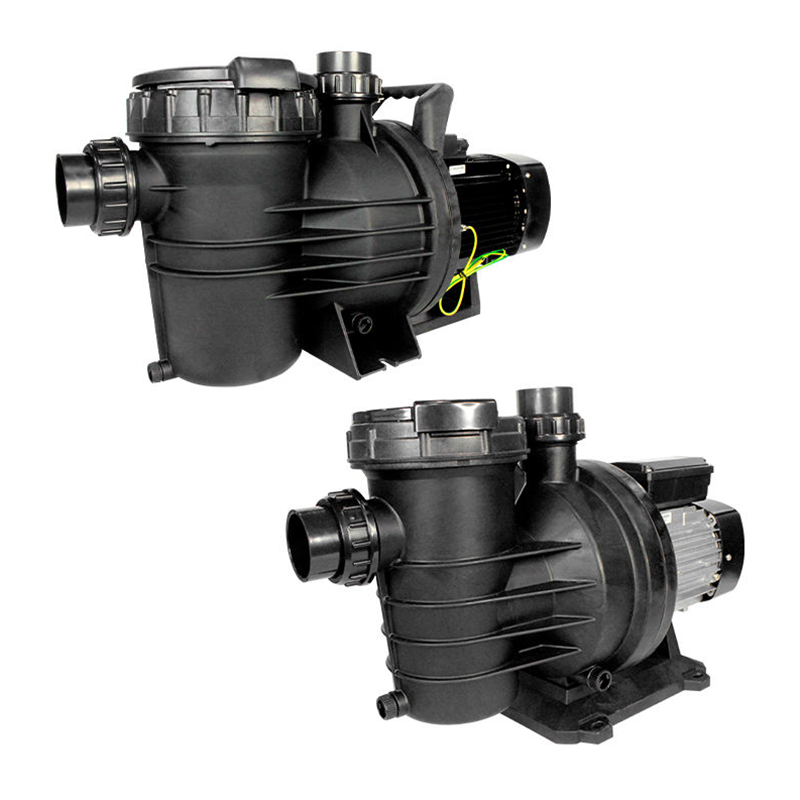
Evaluating Solution Categories: Residential vs. Commercial Pool Pumps
The operating environment dictates the hardware specifications. Installing residential equipment in a commercial facility will void the warranty and lead to rapid motor burnout.
Residential Application Requirements
Residential equipment pads prioritize quiet operation, optimized daily filtration cycles, and smart home integration. Most residential setups rely on single-phase 115V or 230V electrical connections. The daily bather load is light, allowing for long, slow filtration cycles that maximize energy efficiency. Homeowners generally look for intuitive digital interfaces that allow them to set daily schedules directly on the drive keypad or via a smartphone app.
Commercial Pool Pump Specifications
Public facilities, hotels, and community centers require heavy-duty hardware. A commercial pool pump must feature continuous duty capabilities. These motors run 24/7 at higher RPMs to meet strict health code turnover mandates.
They feature massive strainer baskets to handle high-debris environments and robust bronze or reinforced thermoplastic impellers. Electrically, commercial environments frequently require three-phase power compatibility. Furthermore, any equipment installed in a public facility must carry mandatory compliance certifications, such as NSF/ANSI Standard 50, to pass local health department inspections.
Critical Evaluation Dimensions and Feature Sets
Beyond sizing and application, specific features dictate whether a new drive will integrate seamlessly into your existing equipment pad.
Automation and Smart Home Integration
If you have an existing automation system controlling your pool lights, heater, and motorized valves, your hardware choice is heavily constrained. Brands utilize proprietary RS-485 digital communication protocols. A Pentair IntelliTouch system communicates best with a Pentair drive. A Hayward OmniLogic system requires a Hayward drive for full variable speed control.
When wiring the RS-485 communication cable, you must strip the wires carefully to avoid shorting the comm port on the main board. Mixing brands often limits you to basic relay controls. Basic relays only allow the automation system to turn the power on and off, completely bypassing the ability to adjust RPMs dynamically for different modes like spa jets or solar heating. Always verify digital handshake compatibility before purchasing.
Saltwater Pool Pump Considerations
Saltwater pools create highly corrosive environments for equipment pads. While the salt concentration is low (typically 3,200 ppm), the ambient moisture around the pad can rust internal motor components quickly. A dedicated saltwater pool pump utilizes a Totally Enclosed Fan Cooled (TEFC) motor design.
Unlike older induction motors that pull outside air through the casing to cool the copper windings, TEFC motors are completely sealed. A rear-mounted fan blows air over the exterior cooling fins, preventing corrosive salt air from reaching the internals. Additionally, you must program the drive to maintain a specific flow rate minimum. Saltwater chlorine generators (SWCG) feature flow switches. If the RPM drops too low, the water velocity will not trigger the switch, causing the chlorinator to throw an error code and stop producing chlorine.
Motor Design and Interface
Modern variable speed drives utilize permanent magnet motors. This is the exact same technology found in electric vehicles. Permanent magnet motors are vastly more efficient than traditional induction motors because they do not require electricity to induce a magnetic field in the rotor.
This design also revolutionizes acoustic performance. Permanent magnet motors running at lower speeds eliminate the high-pitched whine associated with traditional pool equipment. Decibel levels drop significantly, often making the equipment quieter than a standard household refrigerator. This is a massive advantage for equipment pads located near bedroom windows or outdoor living spaces. When selecting a model, you must also choose between onboard digital keypads (ideal for standalone setups) or screenless models that rely entirely on external automation controllers.
Overall Value and Conceptual Trade-Offs
Evaluating the financial impact requires looking past the initial purchase price and understanding the operational lifespan of the equipment.
Upfront Cost vs. Long-Term ROI
The initial purchase and installation premium of a variable speed pool pump is notably higher than legacy models. However, the payback variables heavily favor the upgrade.
Your return on investment timeline depends on local kWh rates, utility rebates, and optimized programming schedules. In regions with high electricity costs, the energy savings cover the initial hardware expense rapidly. Many local utility companies also offer substantial cash rebates for installing an energy efficient pool pump, further reducing the upfront financial burden.
Single-Speed, Two-Speed, and Variable-Speed Realities
There are very few edge cases where variable speed is not the best option. Extremely small above-ground pools might seem like candidates for cheaper single-speed motors, but regulatory constraints make variable speed the most viable long-term solution across the board.
Many buyers consider two-speed motors as a budget-friendly compromise. This is an illusion. Two-speed motors fail to offer the precise flow control needed for modern auxiliary equipment. High speed is often too powerful, wasting energy, while low speed is frequently too weak to push water through a roof-mounted solar heater or activate a suction cleaner. True variable speed drives allow you to dial in the exact RPM needed for each specific task, maximizing efficiency without compromising hydraulic performance.
Implementation Risks and Mitigation Strategies
Improper installation will negate all efficiency gains and void the manufacturer's warranty. You must address electrical and hydraulic constraints before bolting the hardware to the pad.
Electrical and Wiring Constraints
Verify your voltage requirements. Most high-performance variable speed drives require a 230V connection. If your pad only has 115V service, you will need an electrician to pull new wire and upgrade the breaker panel. You must also ensure the motor is properly bonded to the pool's grounding grid using an 8 AWG solid copper wire to prevent galvanic corrosion and electrical shock hazards.
A major implementation risk involves Ground Fault Circuit Interrupter (GFCI) breakers. Variable frequency drives naturally leak a tiny amount of high-frequency current to the ground during operation. This often causes nuisance tripping with standard Class A GFCI breakers. You must select GFCI breakers specifically rated for high-frequency drives, such as specific Siemens or Square D models, to prevent random shutdowns.
Plumbing and Pad Modifications
Retrofitting a new brand into an existing plumbing setup rarely aligns perfectly. You rarely get lucky with union threads matching between a 15-year-old single-speed and a modern drive. You will likely need to cut the PVC back, glue on new high-temp unions using heavy-duty gray cement, and adjust equipment pad heights. Frame sizes differ between manufacturers, meaning the inlet and outlet ports will sit at different elevations. You may need to pour a new concrete leveling pad or use composite risers.
The most critical hydraulic requirement is maintaining a straight pipe run into the pump inlet. Water entering the volute must be calm and linear. You must install a straight length of PVC equal to at least five times the pipe diameter directly in front of the inlet. If you have 2-inch pipe, you need 10 inches of straight pipe before any elbows or valves. Placing a 90-degree elbow directly in front of the inlet creates turbulent water, leading to cavitation, noisy operation, and premature impeller wear.
Conclusion
Measure your pool dimensions to calculate the exact total water volume in gallons.
Inspect your equipment pad to document the outside diameter of the PVC pipe entering the pump inlet and identify your current automation system brand.
Consult a licensed pool professional to calculate your Total Dynamic Head (TDH) and select a compatible drive that matches your hydraulic profile.
Verify your electrical panel has the correct 230V service and high-frequency rated GFCI breakers before beginning the installation process.
FAQ
Q: How much money does an energy efficient pool pump actually save per year?
A: Savings depend entirely on your local electricity rates and pool size. By utilizing the Pump Affinity Law to run the motor at lower speeds, most homeowners reduce their pool-related energy consumption by 70% to 90%. This allows the equipment to pay for itself rapidly, often within one to two years of installation.
Q: Can I install a variable speed swimming pool pump myself, or do I need a professional?
A: Professional installation is mandatory. Variable speed drives require high-voltage electrical work, specific GFCI breaker sizing, and precise PVC plumbing modifications. Furthermore, most major manufacturers will completely void the warranty if the unit is not installed by a licensed pool professional or certified electrician.
Q: What size variable speed pump do I need for a standard 20,000-gallon pool?
A: A 1.5 to 2.0 horsepower motor is typically sufficient for a 20,000-gallon pool. However, sizing must account for your pipe diameter and Total Dynamic Head (TDH). A 2.0 HP drive allows you to utilize the oversize and under-run strategy, achieving the required flow rate at very low, energy-saving RPMs.
Q: Are two-speed pool pumps a good alternative to variable speed pumps?
A: No. Two-speed pumps lack the precise RPM control required for modern pool systems. Their low speed is often too weak to trigger saltwater chlorinators or gas heaters, while their high speed wastes energy. Variable speed drives allow you to dial in the exact flow rate needed for every specific piece of auxiliary equipment.
Q: Does running a pump at a lower speed negatively affect my pool's water clarity and chemistry?
A: Running at a lower speed actually improves water clarity. Slower water velocity through the filter prevents dirt and debris from being forced past the media. Additionally, running the motor continuously at a low speed ensures constant chemical distribution, preventing stagnant areas where algae can bloom.
Q: Do I need a specific saltwater pool pump if I have a salt chlorine generator?
A: You need a drive with a Totally Enclosed Fan Cooled (TEFC) motor. Saltwater environments create corrosive air around the equipment pad. TEFC motors are sealed against outside moisture, preventing salt air from corroding the internal copper windings. You must also ensure the drive runs fast enough to trigger the chlorinator's flow switch.


