Buying a salt water chlorinator based exactly on the manufacturer’s maximum gallon rating is a massive mistake. Pool owners frequently purchase a 20,000-gallon unit for a 20,000-gallon pool, assuming the label guarantees adequate sanitation. This assumption leads to chronic water chemistry problems. Manufacturer ratings assume 24/7 pump operation under perfect laboratory conditions. They test these units indoors without sunlight, bathers, or organic debris. Relying on these baseline numbers leaves you with an undersized system. You will experience chronic low chlorine levels during peak summer months, and your system will struggle to keep up with basic sanitation demands. Running an undersized unit at 100% output causes premature cell death. The internal plates burn out rapidly under constant maximum load. You must calculate true operational requirements by factoring in actual pool volume, climate conditions, bather load, and realistic pump schedules to select a system that provides long-term reliability.
Key Takeaways
The Golden Rule—Size Up, Not Down: Never size a system to match your exact pool volume; manufacturer maximums represent absolute limits, not practical operational targets.
Apply the Sizing Multiplier: Use the industry-standard 1.5x to 2x multiplier rule to ensure adequate chlorine production without forcing the pump to run 24 hours a day.
Factor in Environmental Stress: High UV indexes, heavy bather loads, and elevated water temperatures drastically increase chlorine demand, requiring a higher daily output rating (lbs/day).
Why Manufacturer Gallon Ratings Are Misleading
Understanding how manufacturers determine capacity ratings reveals why exact sizing fails in residential backyards. Laboratory testing methodologies do not reflect real-world pool operation. You must look past the marketing numbers on the box and understand the physics of chlorine generation.
The 24/7 Operation Assumption
Manufacturers determine maximum capacity ratings by running the cell continuously in a controlled environment. They operate the unit at 100% output for 24 hours a day in indoor tanks. This testing environment lacks sunlight, fluctuating temperatures, and swimmers. It represents the absolute maximum volume of water the unit can theoretically sanitize if it never turns off and faces zero environmental chlorine demand.
Residential pump schedules look entirely different. Most pool owners run their pumps for 8 to 12 hours in the summer. Winter schedules often drop to 4 to 6 hours daily. If your pump only runs for 8 hours, your chlorinator only operates for 8 hours. An exact-sized unit physically cannot produce enough chlorine in that shortened timeframe. It will only generate one-third of its rated daily capacity, leaving your water vulnerable to algae blooms.
The Impact of Under-Sizing on Cell Lifespan
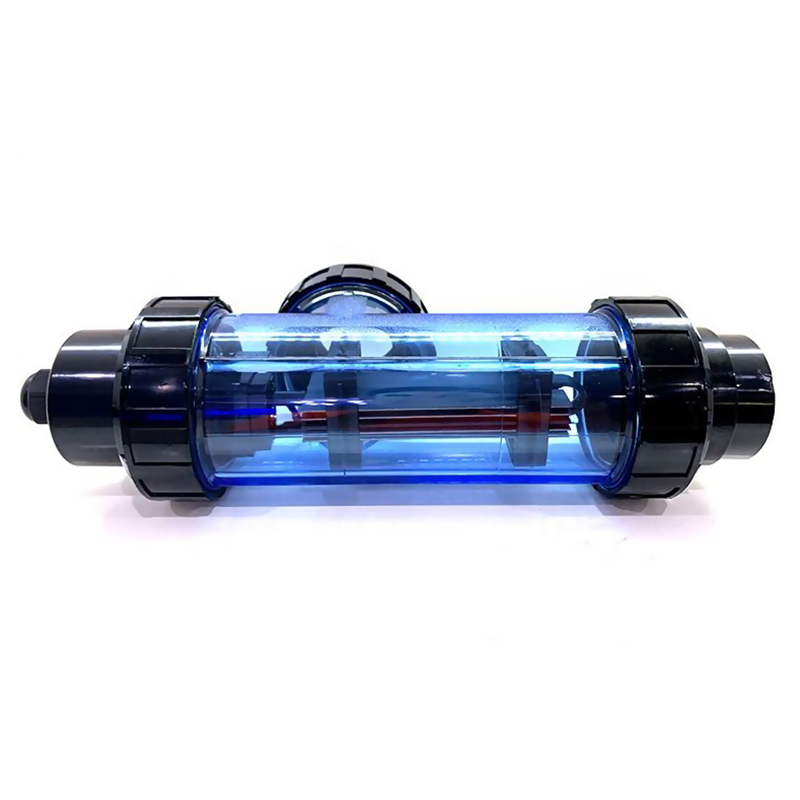
A salt chlorine generator relies on a finite resource to function. The internal titanium plates feature a microscopic precious metal coating. This coating usually consists of ruthenium and iridium. The electrolysis process slowly consumes this coating every time the cell powers on and generates chlorine gas.
Running an undersized cell at 100% capacity burns through this precious metal coating rapidly. You force the unit to work at its absolute limit every single day just to maintain a baseline free chlorine level of 3.0 ppm. This constant electrical strain generates excess heat at the terminal connections and typically destroys the cell in two to three years. Conversely, an oversized cell running at 40% to 50% capacity experiences significantly less wear. The plates stay cooler, the coating degrades slower, and the hardware easily lasts five to seven years under normal field conditions.
Step 1: Calculating Accurate Pool Volume
You cannot size your equipment correctly without knowing your exact water volume. Guessing leads to improper chemical dosing and inadequate sanitation hardware. A 3,000-gallon miscalculation completely changes your equipment requirements.
Formulas for Standard Pool Shapes
Calculating the volume of standard geometric pools requires basic measurements. You need the maximum length, maximum width, and average depth. Measure the shallow end and the deep end to find the average depth. Add the shallow depth to the deep depth, then divide by two. Always measure from the waterline, not the top of the coping.
| Pool Shape | Volume Formula | Field Example |
| Rectangular | Length x Width x Average Depth x 7.5 | 15' x 30' x 5' avg depth x 7.5 = 16,875 Gallons |
| Round | Diameter x Diameter x Average Depth x 5.9 | 24' x 24' x 4' avg depth x 5.9 = 13,593 Gallons |
| Oval | Long Diameter x Short Diameter x Average Depth x 5.9 | 30' x 15' x 5' avg depth x 5.9 = 13,275 Gallons |
Accounting for Complexities in the System
Freeform pools require a different approach. You must divide the pool into smaller geometric sections. Calculate the volume of each section independently, then add them together. Pay close attention to multiple depth zones, sun shelves, and irregular curves.
Your inground pool chlorinator must handle the entire body of water connected to the circulation system. You must add the volume of attached spas and catch basins. Do not forget extensive underground plumbing lines. A long plumbing run between the pool and the equipment pad holds a surprising amount of water. Add an extra 500 to 1,000 gallons to your total calculation to account for these hidden volumes. If you have an infinity edge with a 1,500-gallon surge tank, that water must be factored into your total sizing math.
Step 2: Applying the 1.5x to 2.0x Sizing Rule
Once you know your exact pool volume, you must apply a sizing multiplier. This multiplier bridges the gap between laboratory ratings and real-world backyard conditions. It provides the operational buffer necessary to keep your water clear during July and August.
Using Sizing Wizards vs. Manual Math
Online sizing calculators and wizards provide excellent starting points. They help you explore different equipment brands quickly. However, you must verify their recommendations against manual multiplier math. Automated tools sometimes default to exact sizing logic to show you a cheaper unit. Manual calculation ensures you select a unit with adequate capacity for your specific backyard environment.
The Baseline Multiplier (1.5x)
The industry standard dictates a minimum viable sizing strategy. You must multiply your actual pool volume by 1.5. A 20,000-gallon pool requires a pool chlorination system rated for at least 30,000 gallons. This represents the absolute minimum buffer you should accept on any installation.
This 1.5x buffer accounts for standard chlorine degradation. Sunlight destroys free chlorine naturally throughout the day. The buffer also compensates for normal pump downtime. It allows the system to generate a full 24 hours' worth of chlorine during a standard 8-hour to 10-hour pump cycle.
When to Use the Maximum Multiplier (2.0x or Higher)
Certain environmental factors demand a larger buffer. You should multiply your pool volume by 2.0 if you face extreme conditions. A 20,000-gallon pool in a harsh environment needs a 40,000-gallon system to maintain proper sanitation.
Climate and UV Exposure: Sunbelt regions experience intense sunlight. High UV indexes in Florida, Texas, Arizona, and Southern California destroy free chlorine rapidly. You need maximum production capacity to outpace the sun.
Usage Patterns: High bather loads consume chlorine quickly. Sweat, sunscreen, body oils, and organic waste deplete sanitizer levels immediately upon contact. Frequent pool parties or commercial-adjacent usage require a 2.0x multiplier.
Environmental Debris: Pools without automatic covers face constant organic intrusion. Leaves, pollen, grass clippings, and dirt consume chlorine as they break down in the water. Pools surrounded by heavy landscaping need higher daily chlorine output.
High Water Temperatures: Pools equipped with heat pumps or gas heaters that maintain water temperatures above 85°F breed bacteria exponentially faster, requiring a massive increase in daily chlorine production.
| Actual Pool Volume (Gallons) | Minimum Rating (1.5x Multiplier) | Recommended Rating (2.0x Multiplier) |
| 10,000 | 15,000 Gallon Unit | 20,000 Gallon Unit |
| 15,000 | 22,500 Gallon Unit | 30,000 Gallon Unit |
| 20,000 | 30,000 Gallon Unit | 40,000 Gallon Unit |
| 25,000 | 37,500 Gallon Unit | 50,000 Gallon Unit |
| 30,000 | 45,000 Gallon Unit | 60,000 Gallon Unit |
Step 3: Aligning Chlorinator Output with Pump Run Times
Gallon ratings serve as a helpful shorthand for consumers. However, true system sizing relies on daily chlorine production metrics. You must align the unit's output capabilities with your specific equipment schedule and hydraulic setup.
Evaluating Chlorine Output Ratings (lbs/day)
Shift your focus from generic gallon ratings to actual production metrics. Manufacturers list a pounds-per-day (lbs/day) specification on every unit. This number indicates exactly how much pure chlorine gas the cell produces in 24 hours at 100% output. A standard 40,000-gallon cell typically produces between 1.4 and 1.5 lbs of chlorine per day.
You must calculate your daily requirement. If your pool needs 0.5 lbs of chlorine per day to maintain a 3.0 ppm residual, and the cell produces 1.5 lbs in 24 hours (which equals 0.0625 lbs per hour), the math becomes clear. The pump must run for 8 hours at 100% output to meet the baseline demand. A smaller cell producing only 0.75 lbs per day would require the pump to run for 16 hours to generate that same 0.5 lbs.
Seasonal Adjustments and Water Temperature
Water temperature shares a direct correlation with chlorine demand. Algae and bacteria multiply rapidly in warm water. Cold water suppresses organic growth and preserves free chlorine for much longer periods.
You must adjust your output percentage and pump run times seasonally. Dial back the output percentage on the control board when water drops below 65°F. Reduce pump run times to 4 or 5 hours in the winter. Peak summer requires the opposite approach. You will likely run the pump for 8 to 12 hours and increase the cell output percentage to 60% or 80% to maintain proper sanitation during heat waves.
Single-Speed vs. Variable Speed Pump Integration
A pool salt chlorinator requires a minimum flow rate to activate. The system uses a mechanical flow switch as a safety mechanism. If water does not flow fast enough (usually requiring at least 15 to 25 gallons per minute), the switch remains open, and chlorine production halts to prevent explosive hydrogen gas buildup in the plumbing.
Variable speed pumps introduce a unique challenge. Running a variable speed pump at very low RPMs (e.g., 1,200 RPM) saves massive amounts of energy. However, low RPMs often fail to push enough water to trigger the chlorinator's flow switch. You must schedule high-speed cycles carefully. Ensure the pump runs fast enough (e.g., 2,400 RPM) during a dedicated chlorination window to engage the switch and generate adequate daily chlorine.
Evaluating Hardware Lifespan and Energy Consumption Profiles
Selecting the right equipment involves balancing immediate performance with long-term durability. Oversizing the unit changes how the hardware operates on a daily basis and directly impacts your utility bills.
Hardware Wear and Tear
Compare the operational stress of a 40K-gallon system versus a 60K-gallon system on a 25,000-gallon pool. The smaller system must work significantly harder. You will likely run it at 80% to 100% output during the summer. This constant maximum load strips the ruthenium coating from the titanium plates quickly and degrades the plastic cell housing through thermal stress.
The 60K-gallon system achieves the exact same daily chlorine production at 40% to 50% output. The plates experience less electrical stress. The coating degrades at a much slower rate. The control board components run cooler. This strategy prevents premature cell failure and extends the operational life of the hardware by several years, keeping your pool out of commission less frequently.
Energy Consumption Profiles
Pump operation dictates a large portion of your monthly energy usage. An undersized cell forces you to run the pump longer just to generate enough sanitizer. Running a smaller saltwater pool system at 100% output for 16 hours consumes massive amounts of electricity, negating any efficiency gains from modern pool equipment.
A larger system produces chlorine much faster. You can run a larger system at 50% output for just 8 hours. This achieves the exact same sanitation level while cutting pump run time in half. Optimizing your electrical usage requires a cell capable of rapid chlorine generation during shorter, high-speed pump cycles.
Implementation Risks and Startup Considerations
Proper sizing only works if you execute the installation and startup correctly. Mishandling the initial water chemistry or plumbing ruins even the best equipment within weeks of installation.
Measuring and Calculating Initial Salt Loads
You must test your current water salinity before adding any salt. Use a calibrated digital meter or a reliable drop test. Do not rely on test strips for this initial measurement. Most fresh tap water contains a baseline salinity. Existing pool water often hovers around 500 ppm to 1,000 ppm due to liquid chlorine usage over the years.
Reaching the standard 3,000 to 3,500 ppm operating range requires precise math. Bridging a 3,000 ppm gap in a 25,000-gallon pool requires approximately 626 lbs of salt. You must translate total pounds into standard retail units. Divide 626 lbs by 40 to determine you need roughly 15.5 standard 40-lb bags of pool salt. Broadcast the salt evenly across the deep end. Brush the salt vigorously until it dissolves completely. Wait 24 hours with the pump running before turning on the cell to prevent highly concentrated salt slugs from damaging the plates.
| Current Salinity (ppm) | Target Salinity (ppm) | Pounds of Salt Needed (Per 10,000 Gallons) |
| 0 | 3,200 | 267 lbs |
| 500 | 3,200 | 225 lbs |
| 1,000 | 3,200 | 184 lbs |
| 1,500 | 3,200 | 142 lbs |
| 2,000 | 3,200 | 100 lbs |
Water Chemistry Prerequisites
Never turn on the salt cell before balancing your core water chemistry. You must adjust Cyanuric Acid (CYA), pH, and Total Alkalinity first. CYA protects the newly generated chlorine from sunlight degradation. Maintain CYA between 50 and 70 ppm for salt pools. Without it, the cell produces chlorine that disappears instantly under UV light.
Improper Langelier Saturation Index (LSI) levels cause catastrophic damage. Salt cells naturally aerate the water, which drives the pH upward. High pH and high alkalinity create a scaling environment. This leads to immediate calcium scaling on the new cell plates. Scale insulates the plates, stops electrolysis, and forces the unit to display low-salt or check-cell error codes. Balance your LSI to a slightly negative state (-0.1 to -0.2) before powering the unit.
Plumbing and Space Requirements
Outline the physical installation constraints before cutting any pipes on the equipment pad. The system requires a specific length of straight PVC pipe before the flow switch. Most manufacturers mandate at least 12 inches of straight, unobstructed pipe leading into the cell or the standalone flow switch.
This straight run prevents water turbulence. Turbulence causes the flow switch paddle to bounce back and forth. A bouncing paddle sends false readings to the control board, interrupting chlorine production and triggering false alarms. Ensure your equipment pad has enough physical space to accommodate this straight plumbing requirement. Always install threaded unions on both sides of the cell to allow for easy removal during winterization and routine acid washing.
Conclusion
Measure your exact pool dimensions today using a fiberglass tape measure to calculate your true water volume.
Test your baseline salinity with a digital meter or drop test kit before purchasing any bags of salt.
Audit your current summer pump run times to determine your actual daily chlorination window.
Apply the 1.5x to 2.0x multiplier to your calculated volume to establish your minimum equipment rating.
Select an oversized system that effortlessly matches your required lbs/day output within your existing pump schedule.
FAQ
Q: Can a salt water chlorinator be too big for a pool?
A: No. A larger unit simply runs at a lower output percentage or for shorter durations. This extends the cell's lifespan and provides a buffer for heavy usage or extreme heat. You control the output via the control board, so it will not over-chlorinate the water if adjusted properly.
Q: How many pounds of salt do I need for a new saltwater pool system?
A: It depends on your pool volume and current salinity. If starting at 500 ppm, reaching 3,200 ppm in a 10,000-gallon pool requires about 225 pounds of salt. Always test the water before adding salt to avoid over-salting, which requires partially draining the pool to fix.
Q: Does a pool salt chlorinator run at the same time as the pump?
A: Yes. The chlorinator only generates chlorine when water flows through the cell. The system relies on a mechanical flow switch to activate. If the pump turns off, chlorine production stops immediately to prevent hazardous hydrogen gas buildup in the PVC pipes.
Q: How long should a salt chlorine generator last?
A: A properly sized cell typically lasts five to seven years. If the unit is undersized and forced to run at 100% output continuously, the precious metal coating will degrade much faster, often failing in just two to three years of seasonal use.
Q: What happens if my inground pool chlorinator is undersized?
A: An undersized unit struggles to maintain adequate free chlorine levels. You will experience chronic algae blooms during peak summer heat. The cell will also wear out prematurely because it must run at maximum capacity constantly just to keep up with baseline demand.
Q: Can I use water temperature to calculate chlorinator run time?
A: Water temperature heavily influences chlorine demand. Warmer water requires longer run times and higher output percentages. When temperatures drop below 65°F in winter, you must significantly reduce run times and output percentages to prevent over-chlorination and protect the cell plates.
Q: What is the ideal salt ppm for a pool chlorination system?
A: Most systems operate optimally between 3,000 and 3,500 parts per million (ppm). Always check your specific manufacturer's manual, as some models require slightly higher or lower ranges to function correctly without triggering low-salt or high-salt error codes.


