Upgrading or constructing a competitive aquatic facility requires rigorous adherence to safety codes and athletic standards. Deck equipment serves as a primary point of liability and athletic performance. Selecting the wrong swimming pool starting block can result in building code violations, restrict a facility from hosting sanctioned meets, and increase injury risks due to improper water depth alignment or degrading materials. You need equipment that handles heavy daily use, aggressive water chemistry, and explosive athletic forces. This guide provides a technical evaluation framework for selecting, specifying, and installing starting platforms based on facility goals, governing body regulations, and long-term durability requirements. We focus on practical site integration, material selection, and strict code compliance to ensure your deck equipment performs safely year after year.
Key Takeaways
Depth Dictates Viability: A strict legal minimum water depth of 5 feet (1.52m) is required under Up.codes 406.9, with industry-leading aquatic consultants recommending 6 to 7 feet for at least 5 meters (16 feet) from the pool wall to safely install a competition starting platform.
Feature-to-Outcome Alignment: Elite facilities require specific performance features—such as adjustable track start wedges, backfoot systems, and integrated backstroke ledges—to transition a standard block into a true competition-ready environment.
Material Integrity & Engineering: Prioritizing 316L marine-grade stainless steel and high-traction, commercial-grade anti slip starting block surfaces mitigates corrosion, reduces maintenance costs, and limits liability.
Installation Rigor: Successful execution requires thorough pre-installation site audits, precise lane alignment, robust concrete anchoring systems, and mandatory electrical bonding to meet building codes and ensure stability.
Defining Facility Success Criteria: Training vs. Competition Needs
Facilities often misallocate resources by specifying elite competitive features for recreational pools or under-equipping dedicated competitive venues. This misalignment leads to compromised athletic performance and operational headaches. Establishing clear facility goals before procurement ensures the selected equipment matches the daily operational realities of the aquatic center. You have to know exactly who will use the blocks and how often.
Assessing Sanctioned Meet Requirements
Hosting sanctioned swimming events requires strict compliance with governing body regulations. Organizations such as World Aquatics, NCAA, USA Swimming, and NFHS dictate specific equipment mandates. Platform height above the water surface, total surface area, and maximum slope angles vary slightly across these rulebooks. Facility managers must cross-reference their intended competition levels with these structural mandates. If your deck equipment fails to meet these specs, you cannot host official record-keeping events.
| Governing Body | Platform Height (Above Water) | Minimum Surface Area | Maximum Forward Slope |
| World Aquatics (FINA) | 0.5m to 0.75m | 0.5m x 0.5m | 10 degrees |
| NCAA | Max 30 inches (0.762m) | 0.5m x 0.5m | 10 degrees |
| USA Swimming | 0.5m to 0.75m | 0.5m x 0.5m | 10 degrees |
| NFHS (High School) | Max 30 inches (0.762m) | 0.5m x 0.5m | 10 degrees |
Recreational vs. Elite Training Environments
Daily training environments prioritize durability and ease of use. Elite competition pools demand advanced biomechanical features. For multi-use municipal facilities, operational flexibility is paramount. Removable blocks and dual-anchor configurations allow deck staff to clear the area for recreational swimming, water aerobics, or community events. Dedicated training facilities may forgo complex adjustable wedges in favor of fixed, durable platforms that withstand high-volume daily repetition without mechanical failure.
Building Code vs. Governing Body Mandates
A discrepancy often exists between local commercial building codes and athletic organization guidelines. Local regulations establish baseline safety parameters. Athletic bodies focus on competitive fairness. Facilities must achieve overlapping compliance. You must ensure the installation satisfies the strictest requirements of both legal building codes and athletic sanctioning bodies to avoid operational shutdowns. Never assume an athletic standard supersedes a local municipal building code.
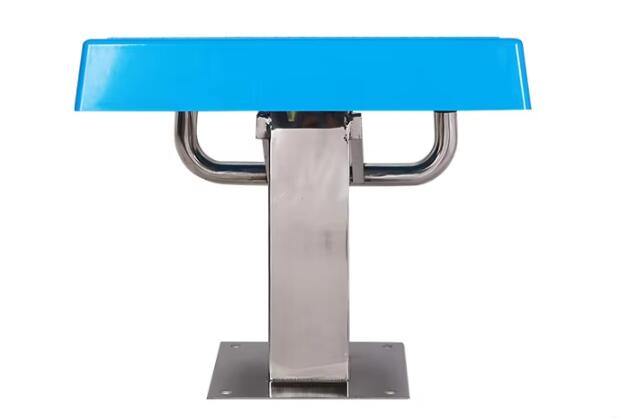
Core Anatomy of a Competition Starting Platform
Understanding the structural components of modern deck equipment allows facility operators to make informed specification decisions. The anatomy of these platforms directly influences swimmer launch mechanics and overall deck safety. You need to evaluate the frame, the mounting hardware, and the interactive surfaces.
Top Configurations: Single vs. Two Step Designs
Platform configurations depend heavily on existing deck architecture. A single-step design suits flush deck profiles where the platform height naturally meets regulatory standards. Conversely, a two step starting block becomes necessary when dealing with elevated parapets, wide gutter configurations, or specific deck-to-water height ratios. The dual-step approach ensures athletes can safely mount the platform without compromising the required launch height or encroaching on the structural integrity of the pool edge. It also prevents awkward climbing that can lead to deck injuries.
Track Start Wedges and Adjustable Footrests
Modern explosive forward launches rely heavily on track start wedges. These adjustable backfoot systems provide a biomechanical advantage. They allow swimmers to generate maximum forward propulsion. When evaluating these mechanisms, durability in high-chloramine environments is critical. Sliding track systems offer precise adjustments but require regular maintenance to prevent binding. Pin-based adjustment mechanisms often provide superior longevity in harsh indoor aquatic atmospheres because they have fewer moving parts susceptible to corrosion.
Backstroke Handgrip Bars and Ledges
Backstroke starts require precise grip positioning and lower-body stability. Regulations dictate specific height and width parameters for backstroke handgrips. Integrated grip bars welded directly to the frame offer superior structural integrity compared to bolt-on accessories. Bolt-on parts vibrate and loosen over time. Backstroke starting ledges significantly improve start mechanics. They prevent foot slippage on the timing touchpads during explosive upward launches. You can choose between manual strap systems or automatic retraction systems based on your facility's maintenance capacity.
Evaluation Dimensions: Safety, Materials, and Performance
The physical construction of deck equipment dictates its lifespan and safety profile. Evaluating materials against the realities of a harsh aquatic environment prevents premature degradation and liability exposure. Water chemistry will destroy inferior metals rapidly.
Anti Slip Surfaces
Explosive takeoffs require a high coefficient of friction in constantly wet environments. An effective anti slip starting block prevents slip-and-fall injuries and maximizes power transfer. Surface materials vary widely. You will find sand-treaded fiberglass, molded rubber, textured acrylics, and proprietary high-grip coatings. Facility operators must monitor the degradation timeline of these surfaces. Implement strict replacement protocols when the aggregate wears down and compromises traction. A smooth block is a massive liability.
Structural Materials and Corrosion Resistance
Aquatic environments are highly corrosive. Structural frames and internal reinforcements should utilize 316L marine-grade stainless steel rather than standard 304L. The higher molybdenum content in 316L provides superior resistance to chloride-induced pitting. Protective finishes defend against UV exposure in outdoor facilities and aggressive chloramine accumulation in poorly ventilated indoor natatoriums. Epoxy powder coating provides a durable barrier, while electropolished bare metal offers a sleek, low-maintenance alternative if the steel grade is high enough.
Platform Dimensions and Pitch
Regulatory bodies enforce strict dimensional standards for the top surface area. They typically require minimums of 50cm by 50cm. The forward slope of the platform is equally critical. Regulations generally cap the maximum allowable forward slope at 10 degrees. This precise pitch ensures the swimmer maintains proper balance and optimal joint angles at the mark. It prevents premature forward momentum before the starting signal. If the pitch exceeds 10 degrees, athletes will false start or slip.
Water Depth and Compliance Regulations (Risk Factor)
Water depth is the single most critical safety factor when installing deck equipment. Non-compliance invites severe injury risks and massive liability exposure. You cannot compromise on depth measurements.
Up.codes Section 406.9 and Local Regulations
Legal building codes establish non-negotiable safety baselines. Up.codes Section 406.9 mandates a legal minimum depth of 5 feet (1.52 meters) for any platform intended for competitive swimming. Installing equipment in shallower water constitutes a direct code violation. It immediately invalidates facility safety certifications. Inspectors will flag this during routine audits.
Industry Best Practices for Safety and Depth
While 5 feet is the legal minimum, industry-leading aquatic consultants strongly recommend exceeding this baseline. A minimum water depth of 6 feet, with 7 feet preferred, is the standard for safely absorbing the downward trajectory of elite competitive starts. A true competition starting platform generates significant kinetic energy. You need adequate water volume to decelerate the athlete safely before they contact the pool floor.
Distance and Drop-off Regulations
Depth requirements extend beyond the immediate pool wall. Facilities must maintain the required minimum depth for a specific distance. This is typically 5 meters (16 feet) from the starting wall before the pool floor can safely slope upward. This sustained depth zone protects swimmers during the underwater glide phase of the start. A sudden slope too close to the wall creates a severe impact hazard.
Liability and Code Compliance Audits
Installing equipment in non-compliant depths carries severe legal, insurance, and municipal liability implications. Facility managers should never rely on outdated blueprints. Concrete shifts, and previous renovations may have altered the pool profile. Commissioning independent architectural or engineering depth audits prior to procurement is a mandatory risk mitigation strategy. Verify actual, current water depths with physical measurements.
Installation Realities, Site Preparation, and Deck Integration
Proper installation transforms high-quality equipment into a safe, functional competitive environment. Poor execution compromises structural stability and violates electrical codes. You must treat the installation as a structural engineering project.
Pre-Installation Site Assessment
A comprehensive deck audit precedes any installation. Technicians must measure the exact deck-to-water height, evaluate gutter width, and verify precise lane-center alignment. The assessment must map the placement of timing system junction boxes and deck cabling lines. You must ensure the block footprint does not interfere with electronic race infrastructure. Measure twice, drill once.
Anchoring Systems and Structural Prep
Athletic shear forces demand robust anchoring. Surface-mounted flange anchors suit certain retrofits, but core-drilled, embedded concrete anchors provide superior stability for elite facilities. Installers must verify concrete depth, expansion tolerances, and minimum compressive strength (PSI) requirements. The deck must absorb the repetitive impact of competitive starts without cracking.
Mark precise lane centers and verify alignment with the timing system touchpads.
Core drill the existing concrete deck to the manufacturer's specified depth, ensuring you do not hit existing rebar or plumbing lines.
Clean the core holes thoroughly to remove all concrete dust and debris.
Set the stainless steel anchor jigs using high-strength, non-shrink structural epoxy.
Verify the anchors are perfectly level before the epoxy cures.
Attach the mandatory electrical bonding wire to the anchor lug.
Retrofitting Existing Pool Decks
Older facilities present unique installation challenges. Structural assessments must identify thinning pool decks or compromised concrete. Mitigation strategies for uneven surfaces include custom-pitched anchor setups and precision shim plates. These ensure the final platform remains perfectly level and structurally sound despite deck imperfections. Sometimes, you have to pour a new concrete footer if the existing deck is too degraded.
Grounding and Bonding Requirements
Electrical safety is non-negotiable. The National Electrical Code (NEC) mandates that all metallic deck equipment be properly bonded to the pool's grounding grid. This critical installation step eliminates stray voltage hazards. It protects athletes and staff from electrical shock in the wet deck environment. The bonding wire must connect directly to the anchor system before the final concrete or epoxy pour.
Documentation, and Value Trade-Offs
Strategic procurement involves balancing upfront specifications with long-term operational viability and thorough documentation. You need to look past the initial purchase and consider the lifecycle of the equipment.
Customization vs. Standard Models
Facilities must weigh the benefits of custom powder-coated colors and facility logos against the efficiency of standard factory models. Branding enhances the visual appeal of a competitive venue. Standard models often allow for faster replacement and streamlined maintenance. If a custom-colored part breaks, you might wait weeks for a replacement. Standard parts ship immediately.
Technical Documentation and Specification Sheets
Procuring comprehensive manufacturer documentation is essential for architectural submittals and local inspector approvals. Facility managers must secure data sheets, CAD drawings, Revit files, and structural calculations. This paperwork proves compliance with commercial standards and expedites the permitting process. Do not buy equipment if the manufacturer cannot provide stamped engineering documents.
Warranty Evaluation and Manufacturer Support
A robust commercial warranty should clearly delineate coverage between structural frame integrity and surface tread wear. Domestic parts availability is crucial. Rapid access to replacement wedges, step treads, and handgrips ensures the facility remains fully operational during peak championship meet seasons. You cannot afford to have a lane closed during a major meet because a proprietary pin broke and is on backorder.
Conclusion
Commission a comprehensive, independent water depth survey to verify compliance with local codes and athletic standards before ordering any equipment.
Consult with a structural engineer to evaluate the existing pool deck and determine the appropriate concrete anchoring system for your specific facility.
Request detailed technical specification sheets and warranty documentation from reputable commercial manufacturers to submit for local building permits.
Establish a routine monthly inspection schedule to monitor surface traction degradation, anchor stability, and track wedge functionality.
FAQ
Q: What is the absolute minimum water depth required for a swimming pool starting block?
A: Under commercial building codes like Up.codes Section 406.9, the strict legal minimum water depth is 5 feet (1.52 meters). However, industry best practices and aquatic consultants strongly recommend a depth of 6 to 7 feet to safely accommodate the trajectory of competitive starts.
Q: What is the difference between a standard training block and a competition starting platform?
A: A standard training block is typically a fixed, durable platform designed for high-volume daily use. A competition platform includes advanced biomechanical features like adjustable track start wedges, backstroke ledges, and specialized handgrips to maximize explosive launch power during sanctioned meets.
Q: What does Up.codes Section 406.9 state regarding starting blocks?
A: Up.codes Section 406.9 mandates that any starting platform intended for competitive swimming must be located in an area where the water depth is not less than 5 feet (1524 mm). This is a legal safety baseline to prevent shallow-water impact injuries.
Q: How do track start wedges and backstroke ledges improve swimmer performance?
A: Track start wedges provide a raised, angled surface for the back foot, allowing swimmers to generate maximum forward propulsion and faster reaction times. Backstroke ledges prevent foot slippage on timing pads, ensuring a powerful and stable upward launch during backstroke starts.
Q: When is a two step starting block required instead of a single-step design?
A: A two-step design is necessary when a facility has elevated parapets, wide gutter systems, or a high deck-to-water ratio. The extra step allows athletes to safely mount the platform without compromising the required regulatory height of the main launch surface.
Q: How often should an anti slip starting block surface be inspected and replaced?
A: Surfaces should be visually inspected monthly for wear and tear. Replacement intervals depend on usage volume, but high-traffic facilities typically need to replace or resurface the anti-slip treads every 2 to 4 years to maintain a safe coefficient of friction.
Q: Do commercial pool starting blocks need to be electrically bonded to the pool's grounding grid?
A: Yes. The National Electrical Code (NEC) strictly requires all metallic deck equipment, including starting platforms, to be bonded to the pool's grounding grid. This prevents stray voltage hazards and protects users from electrical shock.


